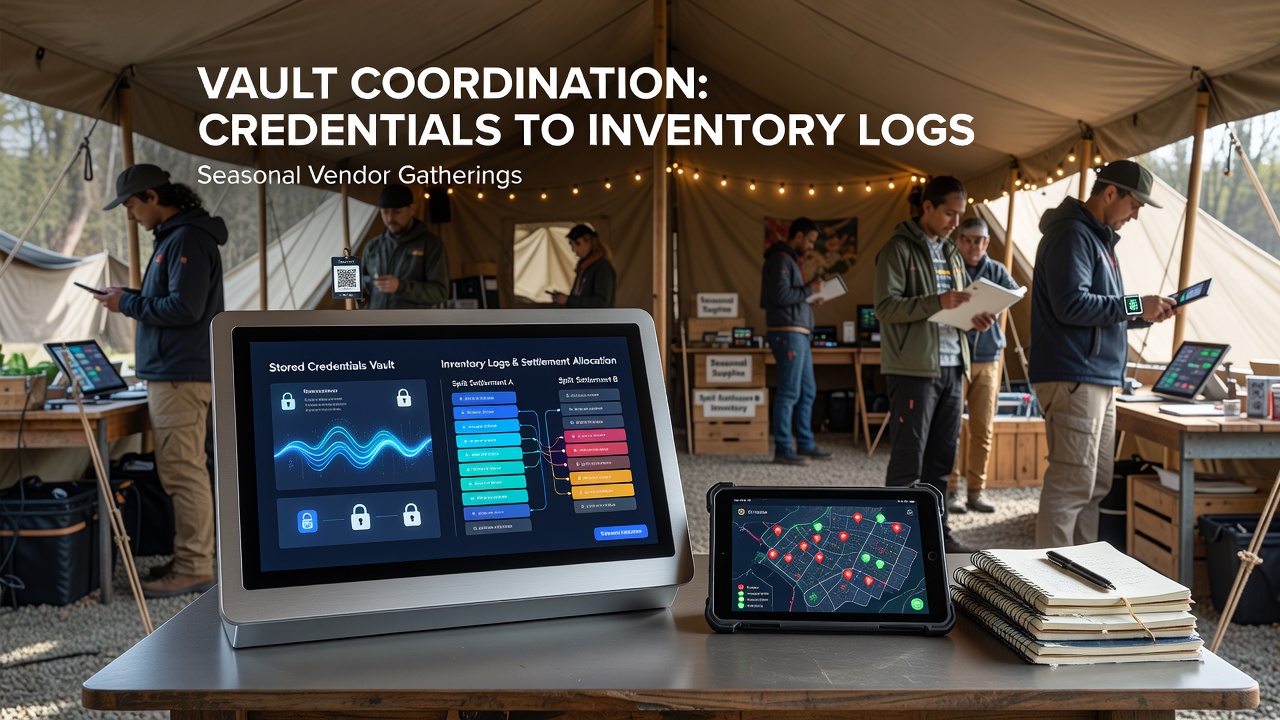
Vault Coordination Methods Linking Stored Credentials to Inventory Logs for Split Settlements in Seasonal Vendor Gatherings
Seasonal vendor gatherings such as summer markets and harvest fairs rely on coordinated systems that connect stored payment credentials with real-time inventory data, and these connections enable precise split settlements among multiple participants. Observers note that credential vaults store tokenized payment information separately from transaction processing layers, which reduces exposure while allowing inventory logs to trigger automatic revenue divisions based on item sales tracked at each stall.
Core Components of Credential Vault Integration
Credential vaults function as secure repositories that hold encrypted card details or bank account tokens, and operators link these entries directly to inventory management platforms through application programming interfaces that record stock levels alongside authorization timestamps. Research from the Bank for International Settlements indicates that such linkages support batch processing where each vendor's portion of a combined sale settles independently without exposing full account data during the exchange. Systems record every item sold against specific credential references, which creates an audit trail that maps sales volume to disbursement amounts for each participant in the gathering.
Inventory logs capture product identifiers, quantities, and unit prices at the point of sale, while vault protocols match these entries to pre-authorized payment instruments. This matching occurs through unique session tokens that expire after each event cycle, and the process supports split calculations that allocate funds according to predefined vendor agreements. Data shows that synchronization prevents discrepancies when multiple stalls contribute to a single customer purchase, such as bundled goods from different suppliers at one checkout station.
Settlement Mechanics Across Temporary Retail Clusters
Split settlements divide transaction proceeds according to inventory contributions recorded in shared logs, and vault coordination ensures that each vendor receives only the portion tied to their recorded sales without requiring separate card captures for every item. Methods include proportional allocation algorithms that reference both credential tokens and stock depletion data, which allows event organizers to release funds in a single batch while maintaining individual accountability. According to the Reserve Bank of Australia, these approaches have been tested in multi-vendor environments where daily reconciliation occurs through automated matching of vault entries against end-of-day inventory reports.
Seasonal events often operate under compressed timelines, so protocols prioritize rapid matching between credential references and inventory updates to finalize splits before vendors disperse. One documented case involved a regional produce fair where vault-linked logs adjusted for returned items by reversing partial authorizations tied to specific stock entries, which maintained accurate balances across all participating growers. The process relies on timestamp synchronization between vault access logs and inventory timestamps to resolve any timing mismatches that arise during peak hours.

Technical Linkages Between Vaults and Inventory Systems
Application interfaces transmit inventory changes to the vault layer in structured data packets that include item codes, vendor identifiers, and calculated shares, while the vault responds with confirmation tokens that authorize the corresponding disbursement. These linkages support conditional triggers where settlement occurs only after inventory reconciliation confirms that stock records match reported sales figures. Observers note that encryption standards such as those outlined by the PCI Security Standards Council protect the data flows between these two systems during transmission.
Additional methods incorporate role-based access controls that restrict which event staff can view or modify the credential-to-inventory mappings, and audit modules log every query that crosses the boundary between the two data sets. In July 2026, updates to certain international payment messaging standards are scheduled to introduce enhanced fields for multi-party settlement references, which will allow seasonal gatherings to embed inventory identifiers directly within vault authorization requests. This change will streamline the matching process for events that span multiple days and involve rotating vendor participation.
Practical Applications in Event-Based Networks
Vendor clusters at seasonal fairs apply these coordination methods to handle mixed payment types, including card-present transactions and pre-ordered digital payments, all routed through the same vault and inventory framework. The system generates settlement files that itemize each vendor's share based on logged inventory movement, and banks or processors receive these files for execution on the next business day. Figures from the Canadian Payment Association reveal that similar coordinated approaches have reduced reconciliation time in temporary retail settings by aligning credential references with stock data before funds leave the central account.
Edge cases arise when inventory adjustments occur after initial authorization, such as substitutions or partial fulfillments, and protocols handle these through amendment tokens that update both the vault record and the corresponding settlement allocation. Event organizers maintain master agreements that define the split ratios in advance, which the system applies automatically once inventory logs confirm the final quantities sold by each participant.
Conclusion
Vault coordination methods establish direct connections between stored credentials and inventory logs that support accurate split settlements at seasonal vendor gatherings, and these connections rely on tokenized references, synchronized timestamps, and automated allocation rules to manage multi-party transactions efficiently. Implementation requires compatible interfaces between payment security layers and stock tracking tools, which produce auditable records suitable for both vendors and event administrators. As standards evolve in 2026, these linkages are positioned to incorporate additional data fields that further refine the precision of revenue division across temporary retail networks.