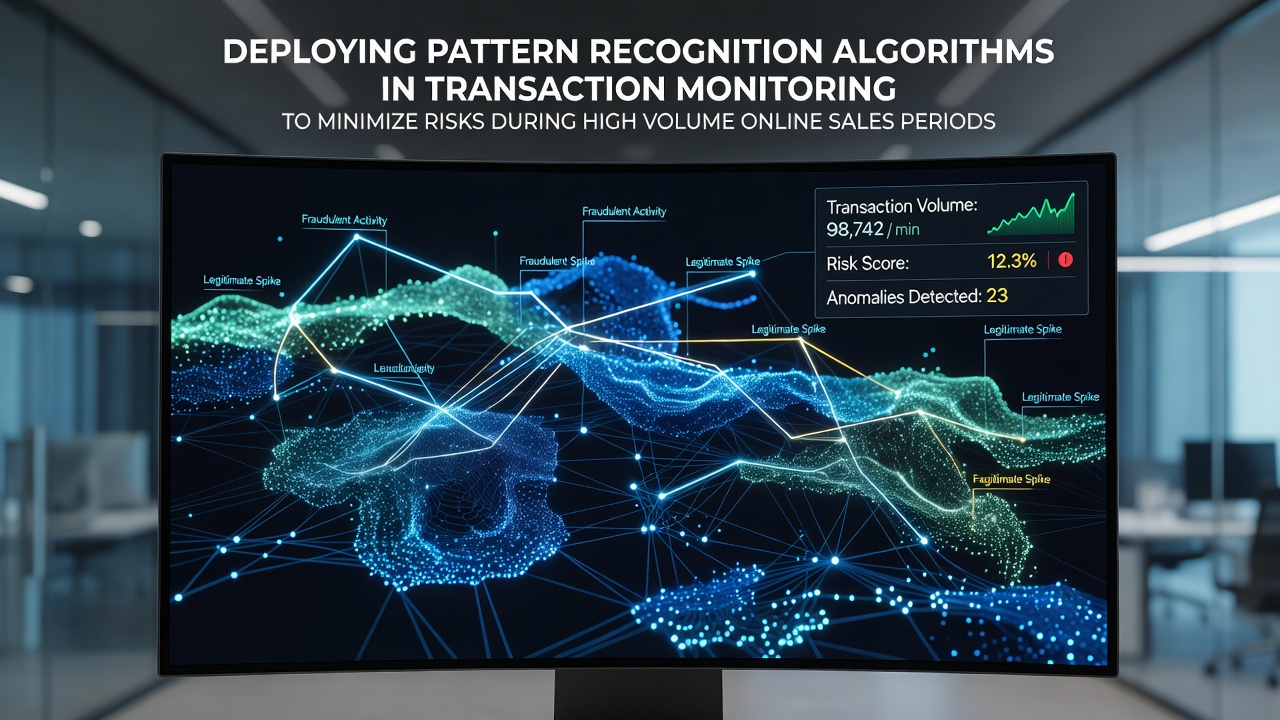
Deploying Pattern Recognition Algorithms in Transaction Monitoring to Minimize Risks During High Volume Online Sales Periods
Pattern recognition algorithms have become central to transaction monitoring systems that handle spikes in online activity, and retailers face elevated exposure to fraud attempts when sales volumes climb sharply. These systems process large datasets to identify deviations from established purchasing behaviors, which helps isolate suspicious activity before funds move. During periods such as the summer sales cycles projected for July 2026, platforms that integrate these algorithms report measurable reductions in unauthorized transactions according to industry data aggregates.
Core Mechanisms Behind Pattern Recognition in Payment Streams
Pattern recognition relies on statistical models that compare incoming transactions against historical baselines derived from millions of prior records. Machine learning techniques including clustering and decision trees flag outliers such as unusual purchase locations, device fingerprints, or velocity patterns that exceed normal thresholds. Researchers at academic institutions have documented how unsupervised learning approaches surface anomalies that supervised models trained on labeled fraud cases might miss, because new attack vectors often lack prior examples.
Real-time deployment requires low-latency architectures that evaluate each authorization request within milliseconds. Systems combine features like IP geolocation, card velocity, and account age into feature vectors that feed into neural networks or random forest classifiers. When a transaction deviates beyond calibrated confidence intervals, the algorithm routes it for additional verification or declines it outright, which limits downstream losses during high-volume windows.
Performance During Peak Sales Windows
High-volume intervals compress the window for manual review, so automated pattern systems become essential. Data compiled by payment networks show that fraudulent activity often rises in proportion to legitimate traffic, particularly when promotional events draw first-time buyers. Algorithms trained on multi-year datasets can distinguish between genuine surges in demand and coordinated testing of stolen credentials because they track correlations across accounts rather than isolated signals.
One documented case involved a mid-sized ecommerce operator that activated enhanced pattern monitoring ahead of a major promotional period. The system identified clusters of micro-transactions originating from a narrow set of IP ranges, which allowed the merchant to implement temporary velocity limits before widespread card testing escalated. Subsequent analysis confirmed that early detection prevented an estimated several thousand dollars in potential chargebacks.

Integration Considerations and Data Requirements
Effective deployment depends on clean, labeled historical data that captures both normal and fraudulent outcomes. Organizations that maintain unified ledgers across channels achieve higher model accuracy because the algorithms receive richer context about customer behavior. Regulators in multiple jurisdictions now expect documented model governance, including periodic retraining and bias audits, to ensure decisions remain consistent across demographic segments.
According to a Federal Reserve analysis of payment fraud trends, firms that combine pattern recognition with device intelligence layers experience lower false-positive rates than those relying on rules alone. European Central Bank publications similarly note that cross-border transactions benefit from models that incorporate currency and merchant category features, because fraudsters frequently exploit differences in regional authorization standards.
Challenges in Scaling and Maintaining Accuracy
Seasonal retraining becomes necessary when consumer behavior shifts, such as changes in preferred payment methods or new product categories. Overly rigid thresholds can generate excessive declines that frustrate customers, while loose parameters allow more fraud to pass. Teams therefore monitor precision-recall curves and adjust operating points as volume forecasts update.
Adversarial actors continue to probe for weaknesses, which means monitoring teams must maintain feedback loops that incorporate newly observed attack patterns into training sets. Continuous evaluation prevents model drift that would otherwise degrade performance precisely when transaction counts peak.
Conclusion
Pattern recognition algorithms provide scalable monitoring capacity that aligns with the demands of concentrated online sales periods. Organizations that maintain robust data pipelines and governance frameworks position themselves to contain risk exposure even as overall transaction counts rise. Ongoing refinement of these systems remains a standard practice among payment processors preparing for events such as the July 2026 sales cycle, where both volume and potential losses can increase simultaneously.